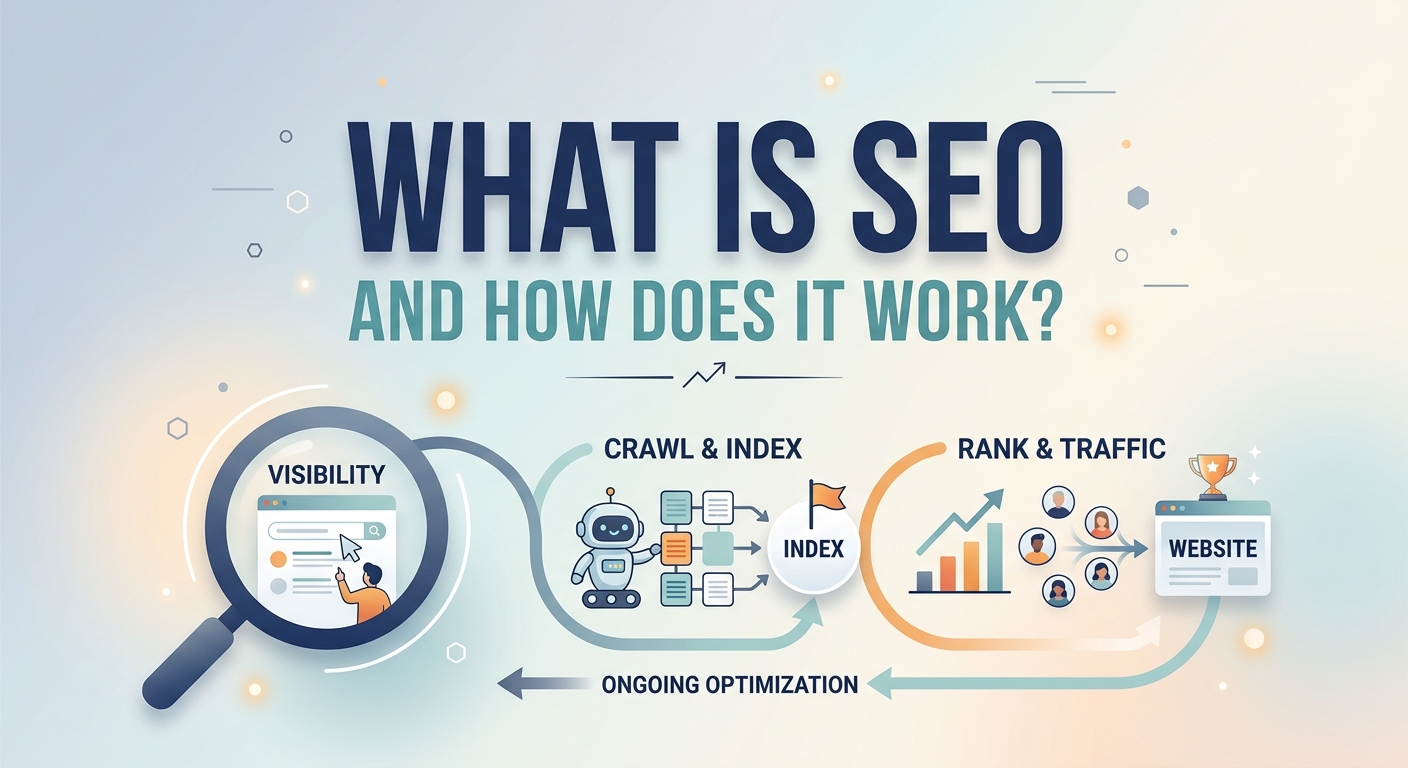
SEO, short for search engine optimization, is the practice of shaping a website so that search engines such as Google can find it, understand it and rank it for the searches people actually type. It works in three stages: a crawler reads the page, an indexing system stores what it found, and a ranking algorithm compares it against every other page competing for the same search before deciding where it appears on the results page. A page ranks well when it is easy to crawl, answers the query clearly, and carries enough trust signals, mainly links from other sites, to convince Google it deserves a top spot. Get those three stages right and a site earns visits it did not have to pay for.
How search engines actually find and rank pages
A search engine works something like a librarian who has read every book in an impossibly large library. Google's crawler, called Googlebot, follows links from page to page and downloads what it finds along the way. That content goes into the index, essentially a searchable copy of the web stored on Google's own servers. When someone types a query, the ranking system scans the index and scores each candidate page on signals such as whether its words match the query, whether other trustworthy sites link to it, how quickly it loads, whether it works properly on a phone, and whether it genuinely answers what the person wanted to know. The pages that score highest on that mix show up first. Nobody outside Google's engineering team knows the exact formula, but the categories above come straight from Google's own published documentation and years of testing across the SEO industry.
Where SEO fits inside digital marketing
Inside digital marketing, SEO earns attention instead of buying it. Paid ads stop the moment a budget runs out, while a page that ranks well can keep bringing in visitors for years without extra spend. Email and social media mostly reach people who already know a brand; SEO reaches people who have never heard of it but are actively typing a related question into Google. People who search what is SEO in digital marketing are usually asking a more specific question underneath: how does a business get found by strangers who are already looking for what it sells? SEO digital marketing strategies answer that by getting a brand's pages in front of someone at the exact moment they are searching. SEO marketing rarely works well alone, though; it tends to perform best paired with content that people also share and link to on their own.
The main types of SEO
SEO is not one technique, it is a set of types of SEO that each cover a different part of a website's visibility, and most real campaigns combine several at once.
On-page SEO
Everything you control directly on a page: the title, headings, content, internal links, and how clearly it answers the query it targets.
Off-page SEO
What happens away from your own site, mainly backlinks from other websites acting as a vote of confidence.
Technical SEO
Making sure a search engine can crawl and render a site without obstacles: broken links, slow load times, duplicate pages or a blocked robots.txt.
Local SEO
Targets searches tied to a place, like "plumber in Kathmandu," and depends on a complete Google Business Profile and consistent listings.
Ecommerce SEO
Applies the same ideas to online stores, with extra attention to product pages, category structure and duplicate content from filters.
YouTube SEO
Accurate titles, descriptions, captions and thumbnails that help YouTube's own search and recommendation system understand a video.
Core SEO concepts every beginner should know
A short list of seo concepts covers most of what shows up in any beginners guide to seo, and doubles as a quick seo for beginners reference:
- Keywords are the words and phrases people type into a search engine. Good SEO starts with finding out what people actually search before writing anything, not after.
- Search intent is whether someone wants information, wants to compare options, or is ready to buy. A page can target the right keyword and still fail to rank if it answers the wrong intent.
- Backlinks are links from other websites, and they carry more weight when they come from sources that are relevant and already trusted.
- Anchor text is the clickable text inside a link. Good anchor text seo practice uses a descriptive phrase, something like "read our guide for beginners" instead of "click here," so both readers and search engines know what the linked page covers.
- Outbound links point away from your site toward other sources. Outbound links in seo are not a weakness: citing solid, relevant external sources on a topic can support a page's trustworthiness rather than undercut it.
- Meta tags are the title and description shown in the search results. They do not directly influence rankings, but they strongly affect whether someone actually clicks through.
Tools that make SEO easier
A handful of tools cover almost everything a beginner needs. Yoast SEO is a WordPress plugin that checks a page's title, meta description, keyword use and readability while you write, which makes it one of the most common starting points for anyone managing their own site. A separate seo audit tool, such as Google Search Console, Screaming Frog or the free crawl in Ahrefs, scans an entire site for crawl errors, broken links and missing tags. A seo backlink checker like Ahrefs, Semrush or Ubersuggest shows which sites link to a page and flags links that might be doing more harm than good. More recently, ai seo tools have started handling repetitive research work, such as grouping keywords or drafting content briefs, though the output still needs a person to check it for accuracy before anything goes live.
How to run a quick SEO checkup on your own site
A basic seo checkup does not need paid software.
- Search your own business name and main keyword in Google and see where you currently show up.
- Open Google Search Console, which is free, and check the Pages report for anything marked "not indexed."
- Test your homepage in Google's PageSpeed Insights and note the mobile score.
- Open your own site on a phone and click through it the way a stranger would, checking for anything slow, broken or hard to tap.
Those four checks alone surface most of the technical problems a small site is likely to have, and take well under twenty minutes.
SEO as a career: training and experts in Nepal
SEO has grown into a full seo career, not just a task added onto someone's marketing job. Agencies and in-house teams now hire specifically for content optimization, technical audits and link building, and freelance SEO work is common because results can usually be delivered remotely.
Interest in seo training in Nepal has grown alongside the country's expanding IT and digital marketing sector, and institutes in Kathmandu increasingly run dedicated SEO courses alongside their broader digital marketing programs. Businesses that would rather hire the work out usually turn to an seo expert in Nepal to handle keyword research, on-page fixes and backlink outreach directly, which matters because search behavior, competition and even the mix of Nepali and English in what people type differ from what a generic international guide assumes.
SEO and web development: why they need each other
SEO web development is the overlap between how a site is built and how well it can rank. Decisions made during development, such as whether pages use clean URLs, whether images are compressed, or whether content loads directly in the HTML instead of depending entirely on JavaScript to build the page afterward, all affect whether a search engine can crawl and rank it in the first place. Fixing an SEO problem caused by a development decision months after launch is almost always more expensive than getting a developer and an SEO person talking to each other before the site goes live.
Common questions about SEO
Is SEO free?
The work itself does not require ad spend, but it costs time, or the cost of hiring someone to do it, plus whatever tools you choose to use.
How long does SEO take to work?
Most sites see meaningful movement within three to six months, and competitive keywords can take a year or longer.
Can I do SEO myself?
Yes, for a small site. On-page fixes, a basic SEO checkup and writing content around real search intent are all within reach without formal training. Larger or more competitive sites usually need more depth than a beginner has time to build alone.
Where to start if you are completely new
Pick one page, usually the homepage or the best-performing service page, and check three things: does the title include the exact phrase people search for, does Google Search Console show the page as indexed, and does it load in under three seconds on a phone. Fixing those three items on a single page teaches most of the mechanics behind the various types of SEO techniques faster than reading about them ever could, and it gives you a real result you can actually measure.