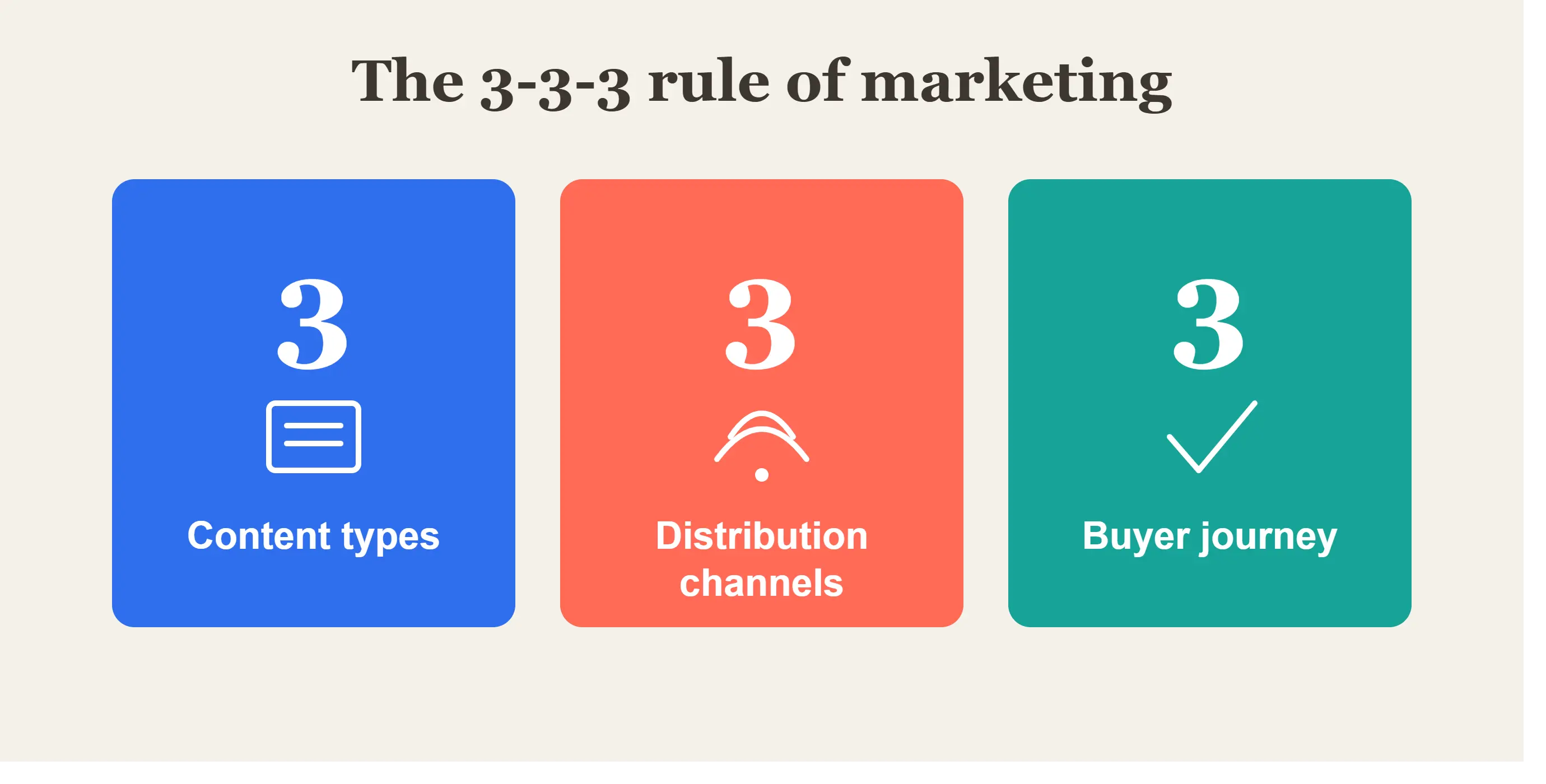
If you've been searching for a simple way to structure your content strategy, the 3-3-3 rule in marketing is a good place to start. It breaks your strategy into three content types, three distribution channels, and three stages of the buyer's journey, so every piece of content has a clear job to do. Some marketers call it the rule of 3 in marketing or marketing rule of three, but the idea stays the same: three inputs, three channels, three moments in the customer's decision. Below is a 3-3-3 rule in marketing example you can apply to your own brand.
Key Takeaways
• The 3-3-3 rule in marketing organizes your strategy around three content types, three distribution channels, and three buyer journey stages.
• It works as a simple marketing framework for small business teams that don't have time for complicated content plans.
• Mapping content to awareness, consideration, decision helps you avoid publishing content nobody needs yet.
• Distribution matters as much as creation, so picking the right key distribution channels in marketing determines whether content gets seen.
• A basic buyer persona helps you decide which three content types and channels actually fit your audience.
The 3 Pillars Of The 3-3-3 Rule Of Marketing
Every version of this approach rests on three pillars: content, distribution, and the buyer's journey. Together they form a content marketing framework for brand growth that's easy to remember, because it forces you to think about who you're creating for, how you're reaching them, and when they actually want it.
Three Content Types to Engage Your Audience
The first pillar covers content types to engage your audience at different points in their decision-making. Rather than producing one format over and over, choose three that work together, for example a blog post for search visibility, a short video for social engagement, and a case study for proof. Rotating between three content types keeps things varied without overwhelming your team.
Three Key Distribution Channels
The second pillar is about picking key distribution channels in marketing and sticking to them. Trying to be everywhere at once usually means being mediocre everywhere. A focused content distribution strategy might rely on organic search, email, and one social platform where your audience actually spends time. When you understand marketing distribution channels explained in the context of your specific audience, three channels done well will always outperform ten done poorly.
Three Stages Of Buyer Journey
The third pillar maps content to the three stages of the buyer's journey. This is the connective tissue of the whole framework. Buyer journey stages explained simply: awareness is when someone realizes they have a problem, consideration is when they compare solutions, and decision is when they choose a provider. This awareness, consideration, decision path is what customer journey mapping is really tracking, and it's how you learn how to align content with buyer journey expectations instead of guessing.
How To Use the 3-3-3 Rule Of Marketing For Brand Growth
Start with a buyer persona. Before choosing content types or channels, get clear on who you're writing for and what they care about at each stage. From there, apply the framework to your own business:
• Pick three content types: blog articles, short-form video, and case studies.
• Pick three distribution channels: organic search, email newsletter, and one core social platform.
• Map each content type to a buyer journey stage: awareness content answers broad questions, consideration content compares options, decision content builds trust.
This structure works well for a small business owner because it limits your choices. You're not trying to master every platform or format, you're building a repeatable system: three inputs, three outputs, three moments in the customer's decision. Review your content marketing plan quarterly, and swap a channel or content type only if the data shows it isn't pulling weight.
Used consistently, this rule becomes an operating rhythm for your brand growth strategy: create with intention, distribute with focus, and meet the buyer wherever they are in the journey.
Frequently Asked Questions
What is the 3-3-3 rule in marketing?
The 3-3-3 rule in marketing is a simple framework that organizes your content strategy around three content types, three distribution channels, and three stages of the buyer's journey. It helps teams create and distribute content with a clear purpose instead of producing content at random.
What are the three pillars of the 3-3-3 rule of marketing?
The three pillars are content types, distribution channels, and buyer journey stages. Each pillar asks a different question: what will you create, where will you share it, and who is it for at each point in their decision.
Is the 3-3-3 rule the same as the rule of three in marketing?
They're closely related. The rule of three in marketing is the broader principle that grouping ideas, channels, or messages in threes makes them easier to remember and act on. The 3-3-3 rule in marketing applies that same principle specifically to content, distribution, and the buyer's journey.
What's an example of the 3-3-3 rule in marketing?
A small business might choose blog posts, short-form video, and case studies as its three content types; organic search, email, and one social platform as its three distribution channels; and awareness, consideration, and decision as its three buyer journey stages, then map each content type to the stage it serves best.
How do I choose the right three distribution channels?
Start with where your buyer persona already spends time, not where it's trendy to post. A focused content distribution strategy across two or three channels you can maintain consistently will outperform a thin presence spread across many.
Does the 3-3-3 rule work for small businesses?
Yes. It works well as a simple marketing framework for small business teams specifically because it limits scope: three content types and three channels are enough to stay consistent without needing a large team or budget.